



Introduction
The Higher Lower game in Python is a popular game-based programming project that combines logical thinking, user interaction, and real-world data concepts.
The Higher Lower game is a comparison-based guessing game. Instead of guessing a number, the user is shown two personalities, brands, or public figures and must decide which one has a higher follower count on a social media platform. Higher lower project is using python version 3.9.5. Python is a general purpose high-level programming. It is useful for developing desktop GUI, websites, and web apps.
At the start of the game, the player is shown two options, usually labeled as Option A and Option B. Basic information is displayed, such as names, professions, or descriptions, but the actual numerical value such as follower count is hidden. The player must decide which option they believe has the higher value. Once a choice is made, the game reveals whether the guess is correct.
If the player guesses correctly, they earn a point and continue to the next round. Typically, one of the previous options remains on screen while a new competitor replaces the other. This creates continuity and increases difficulty as the game progresses. If the player guesses incorrectly, the game ends and the final score is displayed.
This project is widely used by beginners and intermediate learners because it feels realistic, interactive, and entertaining while still being simple enough to understand. This higher lower project encourages analytical thinking, comparison skills, and pattern recognition. When implemented in Python, it helps learners understand conditional logic, loops, data handling, and user interaction in a practical and engaging way.
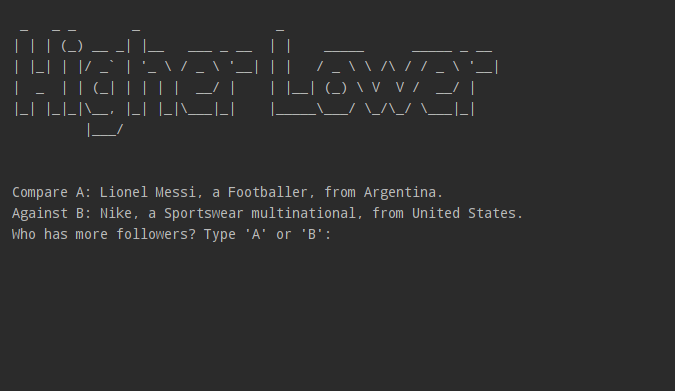
Why higher lower?
- It introduces decision-making logic in a clear way
- It uses user input and output, making it interactive
- It demonstrates loops, repetition, and conditions naturally
- It shows how programs react differently based on user behavior
Core Concept
The Higher Lower game follows a simple logical flow:
- The system displays users or brands option A and option B.
- The displayed brands or name has follower count.
- The player must choose who has the highest follower.
- Feedback is given: higher or lower.
- The process repeats until the incorrect guess is made.
Building the project
The Higher Lower game is developed using the Python programming language and is designed in a modular way, making it easy to understand and extend. This project allows customization, so additional features and improvements can be added as your skills grow.
The core gameplay depends on randomness. A random selection mechanism is used to generate different questions and choose celebrities for each round, ensuring that the game feels fresh every time it is played. The scoring system is straightforward: the player earns one point for every correct guess. As soon as an incorrect answer is given, the game immediately ends and resets, encouraging replay and improvement.
The project is organized into three separate files to maintain clarity and structure. The art.py file contains the ASCII artwork used to enhance the visual presentation of the game. The gamedata.py file stores all the celebrity-related information, such as names and follower counts. The main game logic is handled in the main.py file, where user input, comparisons, and scoring are managed.
To make the game function smoothly, built-in features such as random selection, looping, and conditional decision-making are used. A loop keeps the game running until the player makes a wrong choice, while conditional checks determine whether the guess is correct or not. Overall, this project is an excellent way to strengthen logical thinking and gain practical experience with Python.
How to use this project?
- Install python.
- Download the project.
- Extract the source code.
- Set up an editor or IDE. (vs code, pycharm, anaconda)
- Open the python file in an editor.
- Execute the program.
- Play the game.
- Enjoy and Share!
The Higher Lower game in Python is more than just a game. It is a powerful learning tool that teaches logic, comparison, and interactive thinking through a fun and relatable concept. By using follower-based comparisons, it bridges the gap between abstract programming ideas and real-world applications.
The game is a small project with massive learning value. Hands-on practice is the fastest way to build real programming skills, so download the project, experiment with it, and turn this simple game into a stronger portfolio project.