



Introduction
A Worker Management System in C is a foundational system-level project designed to manage, organize, and process employee-related data using structured programming principles.
A Worker Management System in C is more than just an academic exercise. It is a practical, performance-oriented project that strengthens core programming skills while simulating real workforce management scenarios. By focusing on structured data handling, efficiency, and logical design, the project offers deep insight into how management systems operate at a fundamental level. This type of system focuses on handling essential workforce operations such as storing worker details, updating records, tracking roles, and managing employment information efficiently.
The project, created with the C programming language, focuses on memory management, performance, and logical problem-solving, and is highly beneficial for students and novices seeking a basic understanding of real-world software logic. Unlike modern enterprise systems that rely on databases and frameworks, a Worker Management System in C operates close to the hardware, offering deeper insight into how data is stored, accessed, and manipulated. The primary purpose of a Worker Management System is to centralize and streamline workforce information.
In any organization, managing worker records manually can be time-consuming and prone to errors. A digital management system eliminates redundancy, improves accuracy, and ensures faster access to information. In a C-based system, the focus is not on graphical interfaces or cloud storage but on logical efficiency. The program maintains structured records for each worker, allowing administrators to perform operations such as adding new workers, modifying existing records, searching for specific employees, and reviewing stored data. This mirrors real organizational needs while keeping the implementation simple and educational.
Why use C programming?
C is a procedural programming language valued for its speed, efficiency, and close control over how a computer uses memory. When you build a Worker Management System in C, you are not just creating a simple program you are learning how things actually work behind the scenes. You deal directly with how data is organized, how memory is allocated and released, and how information is stored and retrieved from files. This hands-on experience gives you a much clearer understanding of what happens inside a system when it processes real-world data.
Working on this project also helps strengthen essential programming skills. You learn how to handle structured data carefully, make decisions using conditional logic, repeat operations with loops, and break the program into smaller, manageable parts through modular design. Because C does not offer ready-made tools for managing data as many modern programming languages do, every feature must be planned and implemented manually. This pushes you to think more logically, write cleaner code, and develop a stronger sense of system design.
Beyond learning benefits, C remains highly relevant in today’s technology landscape. It is widely used in operating systems, embedded systems, and applications where performance and reliability are critical. Developing a Worker Management System in C shows that you can build dependable software under low-level constraints. This ability is highly respected in academic environments and often stands out in technical interviews, as it reflects strong fundamentals and a deep understanding of how software systems truly operate
Building the project
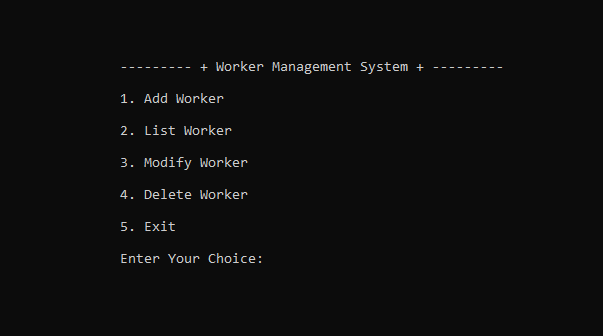
The Worker Management System is designed to be simple, practical, and easy to follow. The add worker feature allows you to register a new worker by entering basic personal details such as name, age, and salary. Once the information is provided, it is automatically saved in a data file, ensuring that the records remain available even after the program is closed. This makes it possible to store and manage information for multiple workers without losing data. The list option displays all stored worker records in an organized manner, making it easy to review existing information at any time.
If any details need to be updated, the modify option allows you to edit a worker’s information. To do this, you simply enter the worker’s name, locate the record, and replace the old details with new, updated information. When a worker is no longer part of the system, the delete option can be used to remove their record completely. By entering the worker’s name, the system identifies and deletes the corresponding data, keeping the records clean and up to date. The exit option safely closes the program once all operations are complete.
Overall, the project is straightforward to understand, even for beginners. The interface is user-friendly, and the workflow is logical, which helps users navigate the system without confusion. The project is open source and free to use, making it ideal for learning and practice. To run the project, a C development environment such as Dev-C++ is required. Download the project, explore its features, and gain hands-on experience by using it yourself.
How to use this project?
- Download the project.
- Get the software Dev C++ or any other editor.
- Open the code in an editor..
- Compile and execute the code.
- Use the project.
- Enjoy!
Take your learning to the next level by exploring the Worker Management System in C hands-on. Download the project, run it in your C development environment, and start experimenting with real workforce data handling.
Modify features, improve logic, and extend the system to match your own ideas. Whether you are a student, beginner, or aspiring system-level programmer, this project is a practical way to strengthen your fundamentals and build confidence. Start working on it today and turn theoretical knowledge into real-world experience.